
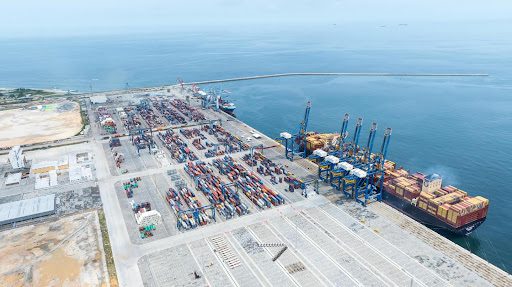
For decades, the economic narrative of Cameroon was a tale of two cities: the administrative stoicism of Yaoundé and the chaotic commercial energy of Douala. However, as we move through 2026, a third power has emerged. Kribi is no longer a seaside resort; it is a global industrial frontier. Driven by the Kribi Deep Sea Port (PAK), the strategic pipeline infrastructure, and a massive government-led push for industrial decentralization, the “Kribi Corridor” has become the most profitable real estate and industrial play in Central Africa. For the serious investor—whether in logistics, residential development, or hospitality—this guide breaks down why the South Region is the definitive choice for capital placement this decade.
Chapter 1: The Macro-Economic Catalyst — The Kribi Deep Sea Port (PAK)
The Gateway to the Gulf of Guinea
The Kribi Deep Sea Port is the single most important infrastructure project in Cameroon’s post-colonial history. Unlike the Port of Douala, which is river-based and requires constant, expensive dredging, Kribi offers a natural deep-water harbor. In 2026, with the completion of Phase II, the port now accommodates the world’s largest “Neo-Panamax” vessels.
What this means for Investors:
- Transshipment Hub: Kribi is now the primary entry point for goods destined for Chad, the Central African Republic, and Northern Congo.
- Industrial Zones: Surrounding the port is a 15,000-hectare industrial-port complex (ZIIPT). This zone offers tax incentives, duty-free imports for equipment, and streamlined bureaucratic processes for manufacturing firms.
- The Multiplier Effect: Every crane at the port represents a need for 100 nearby warehouses, 500 units of housing for workers, and dozens of service-sector businesses (banking, legal, catering).
Chapter 2: The Real Estate Boom — From “Bush” to Gold
The Shift in Land Value
In 2020, land in areas like Mboro or Grand Batanga was viewed primarily through the lens of vacation homes. In 2026, the perspective has shifted to high-density residential and commercial utility.
Strategic Zones for Land Acquisition:
- The South (Mboro/Lolabe): This is the industrial heartland. Demand here is driven by logistics firms and housing for port executives. Titled land here has seen a 25% year-over-year appreciation since 2023.
- The Center (Kribi Town): Space is limited. Investment here is focused on “Verticalization”—demolishing old structures to build multi-story apartment blocks and office spaces.
- The North (Lobe/Londji): This remains the “Luxury Belt.” This is where high-end resorts and private villas for the expatriate and elite class are situated.
The Importance of the “Titre Foncier” (Land Title)
The greatest risk in Cameroonian real estate has historically been land disputes. However, the Kribi administration has modernized the Cadastre (Land Registry).
- Safe Investing: Investors are now prioritizing “Titled Land” over “Customary Land.”
- Digital Verification: In 2026, the push for digital land records means that verifying a title is faster than ever. At KribiCameroon.com, we emphasize that a Titre Foncier is not just a document; it is your insurance policy.
Chapter 3: Sector-Specific Opportunities
1. Hospitality & “Bleisure” Tourism
There is a massive “Quality Gap” in Kribi. While there are many “hotels,” there are very few International Standard Corporate Hotels.
- The Opportunity: Business travelers visiting the Port need 4-star amenities: reliable high-speed fiber internet, soundproof meeting rooms, and international-standard gym facilities.
- Short-Term Rentals: The “Airbnb” market for luxury apartments is undersupplied. Executives staying for 2-week stints prefer “Serviced Apartments” over traditional hotels.
2. Logistics & Warehousing
With the port running at 2026 capacity, the demand for Cold Chain Storage (for Cameroon’s agricultural exports like cocoa and timber) is at an all-time high. Developing “Grade A” warehouse space—secure, climate-controlled, and digitally managed—is currently one of the highest-yield plays in the corridor.
3. Commercial Retail & Services
Kribi’s population is exploding. The city needs modern shopping malls, private healthcare clinics, and international schools. The “First Mover” advantage in these sectors is currently wide open.
Chapter 4: Navigating the Legal and Fiscal Landscape
The Investment Charter
Cameroon’s Investment Code provides significant advantages for those investing in “Development Zones” like Kribi.
- Tax Holidays: New businesses can benefit from exemptions on corporate tax and property tax for up to 5–10 years depending on the size of the capital investment.
- Repatriation of Capital: For international investors, the regulations regarding the repatriation of profits have been clarified to encourage Foreign Direct Investment (FDI).
The Role of the Kribi Port Authority (PAK)
The PAK acts as more than just a port manager; it is a facilitator. They offer “One-Stop-Shop” services for businesses looking to set up within the industrial zone, significantly cutting through the red tape that often hampers business in the Central African sub-region.
Chapter 5: The Diaspora Connection
For Cameroonians living in Europe, North America, and the Middle East, Kribi represents the safest place to “reconnect” capital with the homeland.
- Remittance to Investment: We are seeing a trend of the Diaspora shifting from “Social Remittances” (sending money for family upkeep) to “Productive Investment” (buying land in Kribi to build rental income properties).
- The “KribiCameroon.com” Advantage: Our platform serves as the digital bridge, providing verified listings and local boots-on-the-ground intelligence to those who cannot be physically present.
Conclusion: The Window of Opportunity
In investment, timing is everything. In the 1990s, it was Douala. In the 2010s, it was the Yaoundé expansion. The 2020s belong to Kribi. The infrastructure is built, the port is operational, and the highway is open. The risk profile has lowered, but the rewards remain high. Whether you are looking for a single plot of land to hold for ten years or a multi-hectare site for an industrial plant, the Kribi Corridor is the most significant economic story in Cameroon today.
Don’t just watch Kribi grow. Own a piece of its future.